Belief vs fact: what each character has been told, tracked separately from what's narratively true.
Most software treats facts as facts. Fiction breaks that assumption — the asymmetry of who-knows-what is the engine of the plot. PlotLens reads, doesn't write, and models both layers separately so you can keep the seams where you want them and catch the ones you don't.
What belief vs fact means
PlotLens tracks two parallel sets of state for every character in your manuscript.
Narrative facts are what's actually true in the world of the story — the layer the narrator (or the manuscript itself) is the authority on.
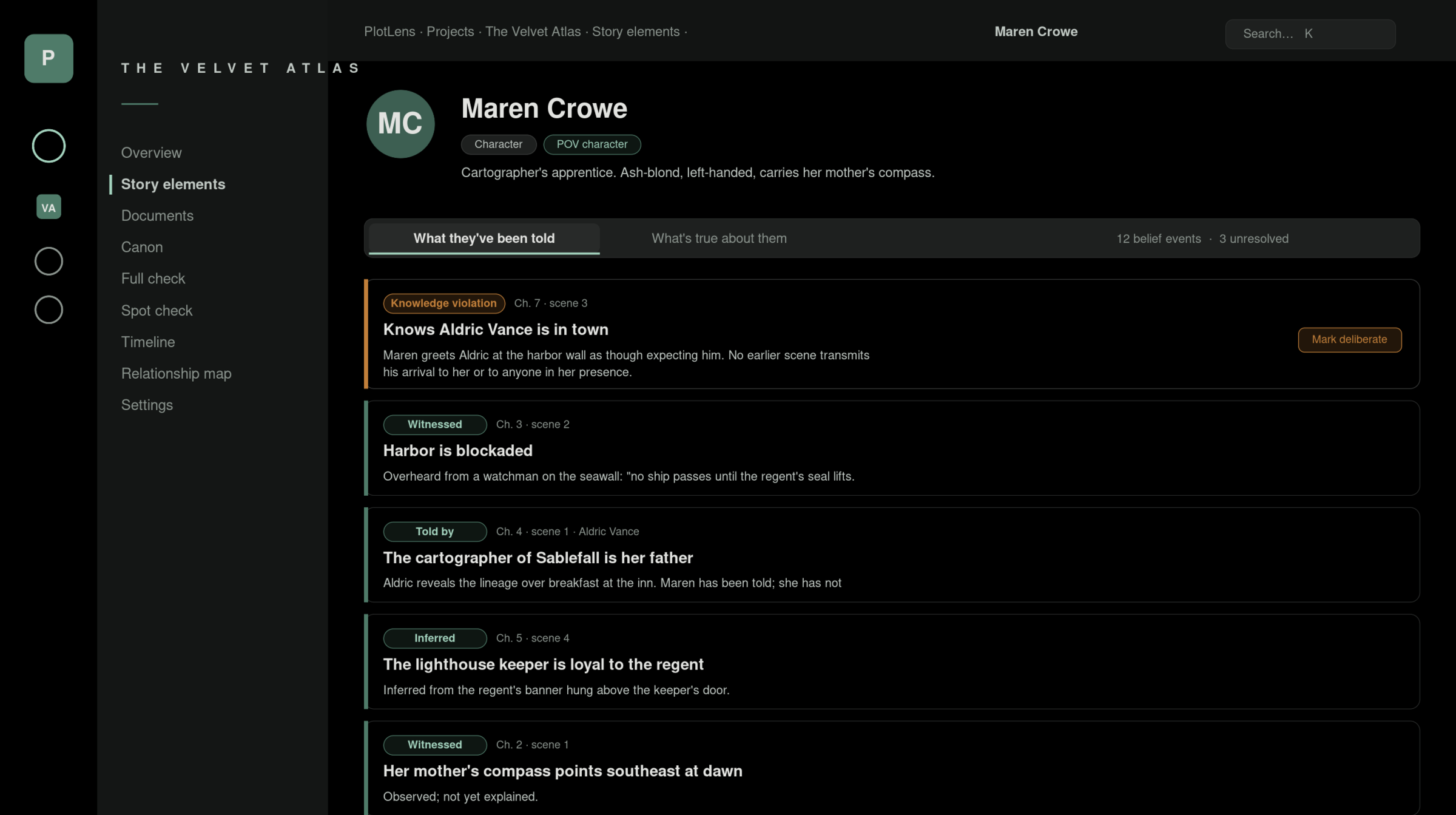
Character beliefs are what each character has been told, has witnessed, or has reason to know — based only on the scenes they've been in and the conversations they've heard.
Both layers are populated from your manuscript and refreshed each time you upload or revise a document. When character A tells character B that her father is dead, the narrative-fact layer records that her father is dead (unless we have reason to believe A is lying), and the character-belief layer for B records that B has been told her father is dead. They might agree. They might not. Plot is what happens at the seams.
Being wrong can be a plot point. Being wrong by accident isn't.
What this catches
Two failure modes that flatter tools either miss entirely or flag in the wrong direction.
Knowledge violations
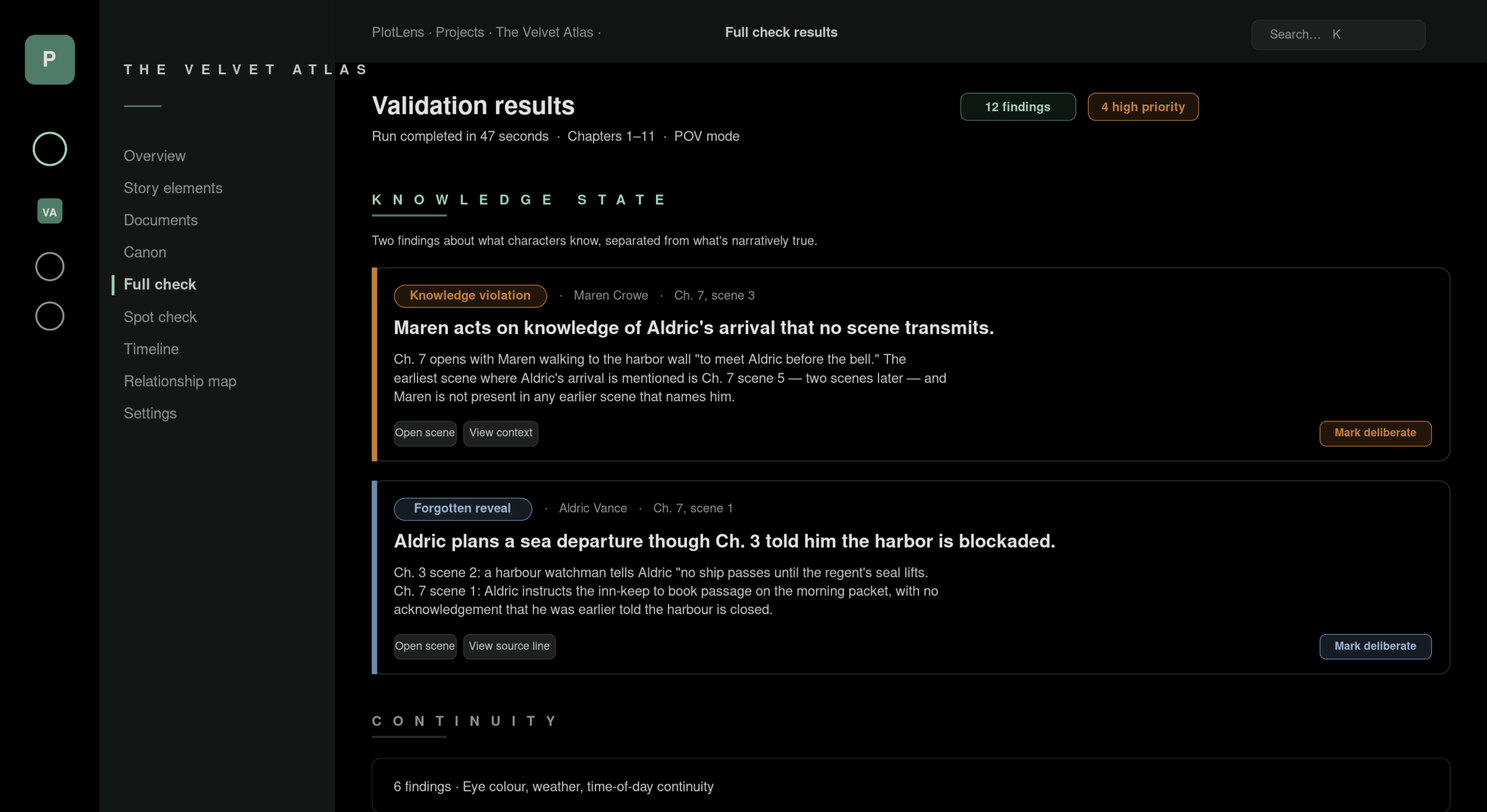
A character acts on information they haven't been told. The protagonist arrives at a meeting already knowing what the killer plans, but the only scene where that plan was discussed happened off-page and she wasn't in it. PlotLens shows you the line where she demonstrates the knowledge — and the absence of the scene that should have transmitted it.
Forgotten reveals
The flip side: a character has been told something, and the manuscript later treats them as if they don't know. Maren told Aldric in chapter four that her father is dead; in chapter eleven, Aldric is unsure whether her father is alive. Either Aldric doesn't trust Maren — a deliberate choice you should be able to keep — or the writer told him and forgot. PlotLens lets you decide which.
Where this matters most
Every fiction genre uses asymmetry of information. Three rely on it.
Mysteries
The detective knows things the reader doesn't, and the reader is gradually given access to what the detective knows. Continuity errors here aren't cosmetic — they're the entire game.
Thrillers
Tension comes from one character knowing what's coming and another character being unaware. Let the unaware character in on the information one chapter early and the climax loses its punch.
Romance
Especially in slow-burn, the will-they-or-won't-they hinges on what each character has and hasn't said out loud. Writers spend chapters carefully managing these states. Software that flattens them is actively harmful.
Speculative fiction inherits the same problem at series scale — who knows about the magic system, who's met which faction, who's discovered the prophecy. Every revelation is an event in a character's belief layer; every silence is a constraint on what they can know later.
Provenance is the proof
A guide is only useful if you can trust it. PlotLens is a guide, not a judge — it surfaces tensions, cites both sides, and lets you decide what to do.
Facts link back to the sentence they came from, when a clean span is available.
Each belief-vs-fact result tells you the character involved, what they appear to know, the scene that should have transmitted the knowledge (or the absence of one), and the sentence where the inconsistency surfaces. You jump straight to the source, re-read the context, and call it yourself.
Marked moments — intentional dramatic irony, unreliable POV, deliberate asymmetry — stop being flagged in future runs. You only ever see the new ones.
Available on the Plus plan and above, for workspaces in the rollout. Plan eligibility and workspace enablement are separate gates — Plus customers whose workspace hasn't been canary-flipped won't see this in the product yet. Rolling out gradually — see the Belief vs Fact docs for plan availability and the current rollout state.
Frequently asked questions
Belief-vs-fact modeling is a piece of how PlotLens delivers Narrative Intelligence — story-aware memory that reads, never writes, and stays accountable to your own words.
See it on your own manuscript.
Start free — no credit card required.
Start free